
At the Clinical Center of the University of Sarajevo (KCUS), one of the largest healthcare institutions in Bosnia and Herzegovina, EHS implemented a comprehensive digital pathology workflow built around G-Path/Patlab and Sectra PACS.
The project connected specimen tracking, slide digitization, laboratory devices, and reporting into a single integrated workflow, improving diagnostic efficiency while maintaining full traceability across the pathology process.
Result
The implementation delivered measurable operational improvements across the pathology workflow.
Key outcomes include:
- Clear and reliable specimen tracking throughout the entire diagnostic process
- Faster processing and reporting of diagnostic results
- Fewer administrative and labeling errors through barcode-based workflows
- Better organization of pathology cases and laboratory processes
- Higher daily efficiency and improved staff productivity
- Improved quality and consistency of pathology diagnostics
In addition, the platform establishes a future-ready foundation for telepathology, AI tools, and data-driven analysis.
Challenge
Pathology workflows are inherently complex, involving multiple steps, laboratory devices, and manual processes that must remain fully traceable from specimen intake to final diagnosis.
At KCUS, the goal was to transition toward digital pathology while ensuring that all parts of the workflow remained connected and reliable.
Key operational challenges included
- Fragmented workflows across laboratory devices and imaging systems
- The need for reliable specimen and slide traceability
- Manual steps in labeling and case tracking that increased the risk of administrative errors
- Limited visibility across the full pathology workflow
- The need to prepare the pathology department for digital collaboration and telepathology
Objectives
The project aimed to establish a fully integrated digital pathology environment that would:
- Standardize pathology workflow from specimen processing to reporting
- Enable reliable specimen and slide traceability using barcode-based processes
- Digitize histology slides and connect them with pathology cases
- Improve efficiency and reduce manual administrative work
- Create a foundation for telepathology and future AI-assisted diagnostics
Solution delivered
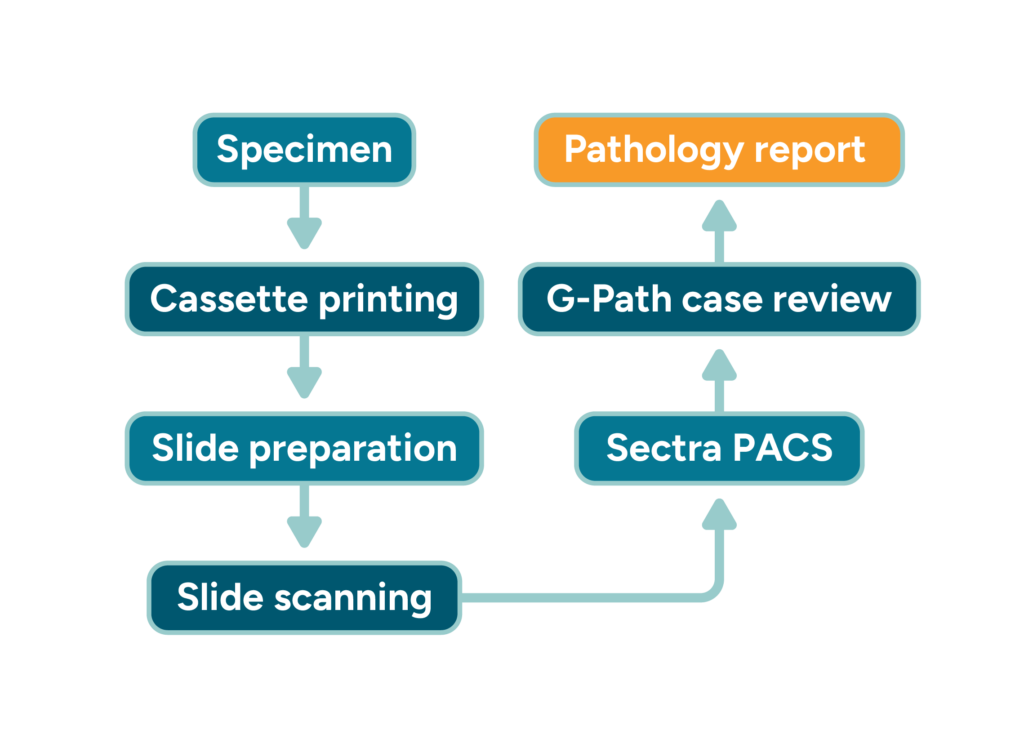
EHS implemented a fully integrated digital pathology workflow built around G-Path/Patlab and Sectra PACS.
At KCUS, G-Path/Patlab serves as the central platform for pathology workflow management, connecting specimen tracking, case management, and laboratory processes with digital slide imaging in Sectra PACS.
Barcode-enabled cassette and slide printers ensure reliable specimen identification, while a macropath camera supports macroscopic documentation. Histological slides are digitized through a slide scanner and stored in Sectra PACS, allowing pathologists to review cases within a unified digital environment.
Integrations & interoperability
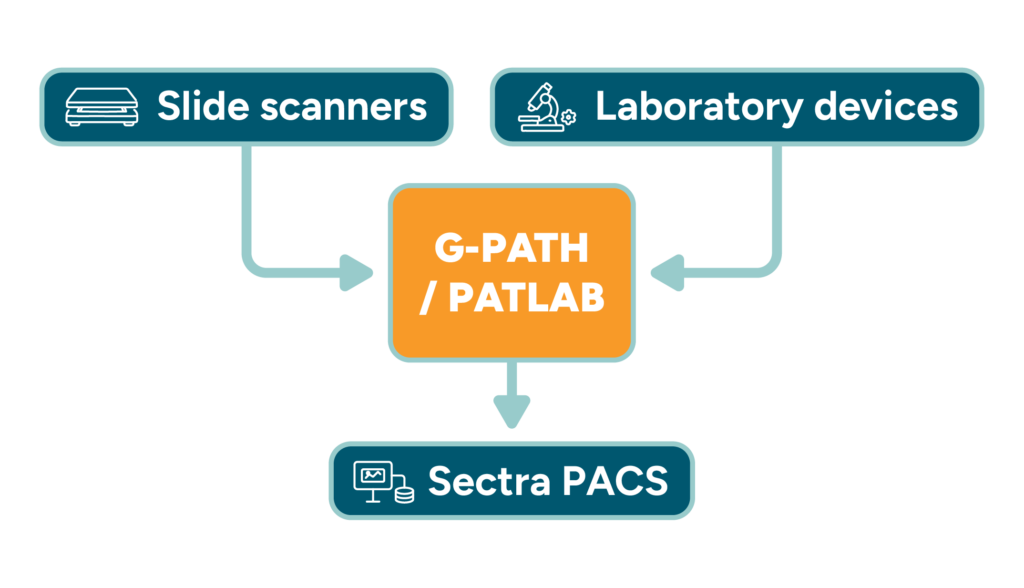
Laboratory devices, digital slide imaging, and pathology case management operate within a single connected workflow.
Specimen data and case information are managed within G-Path, while digitized slides are processed and archived through Sectra PACS. Barcode-based workflows link specimens, slides, and cases, ensuring consistent traceability and reliable data exchange across the pathology process.
Adoption & rollout approach
The transition to digital pathology was introduced gradually to ensure uninterrupted diagnostic operations.
The rollout included the deployment of digital pathology infrastructure, integration of laboratory devices and imaging systems, and training of pathology staff on the new workflow. This phased approach enabled the department to adopt digital pathology while maintaining continuity of daily laboratory work.
Workflow overview diagram
Integration map
“G-RIS has transformed how we manage our radiology workflow. From scheduling to reporting, everything is faster, more organized, and easier to track. The reduction in waiting times is especially noticeable—both for staff and patients. It’s a robust system that supports our growing demands with stability and speed.”
”— Jasmin Osmanović - Chief Radiology Technologist Clinical University Center of Tuzla Bosnia and Herzegovina
“I have introduced G-RIS in my hospital four years ago and since then I have been using it and learning new things every year. What I appreciate most about G-RIS is how easy and intuitive it is to use. The system fits seamlessly into our daily workflow. Our teleradiology network has become a truly connected environment, allowing me to collaborate with colleagues across departments and even remote locations without delay.”
”— Prof.dr.sc. - Vedran Markotić Head of Clinical Department of Radiology at University Clinical Hospital Mostar, Bosnia and Herzegovina

“With G-Health, everything just works better. All our locations are finally connected, and having one shared health record makes a huge difference in day-to-day care. Scheduling runs smoother, and patients love getting their reports instantly through the G-Access portal.”
”— Emina Ratković - Operations manager at Eurofarm Centar Polyclinic, Sarajevo, Bosnia and Herzegovina
Let's get in touch
Ready to modernize your diagnostic operations?
Book a personalized demo or connect with our team to explore partnership opportunities.