
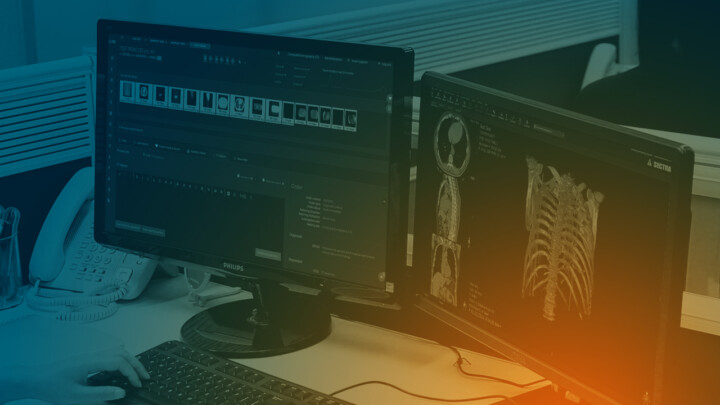
Frictionless RIS-PACS integration
Radiology teams need a smooth, uninterrupted workflow between RIS and PACS. Fragmented systems slow down reporting, increase manual steps, and force radiologists to switch between applications, directly impacting efficiency and turnaround time.
Solution
G-RIS is deeply integrated with Sectra PACS, creating a unified workflow that feels like a single system rather than two connected platforms. This approach supports both RIS driven and PACS driven workflow. From referral and scheduling to image review and reporting, G-RIS acts as the central workflow engine, while Sectra PACS delivers best-in-class image management and visualization.
How it works
- Patient demographics, study status, and exam data are automatically synchronized between G-RIS and Sectra PACS
- Images become instantly available in PACS, with image availability notifications visible in G-RIS
- Radiologists can launch Sectra PACS directly from the G-RIS cockpit using context-aware switching. No manual searching, no duplicate logins
- Key G-RIS modules are fully embedded in Sectra PACS
- Reports are fully synchronized in both directions, ensuring consistency across RIS and PACS
- Triage categories, dose information, and study status are aligned across systems
- When deployed with Sectra ONE, the solution supports multitenant architecture and enterprise imaging workflows
Value delivered
- Faster reporting and improved turnaround time
- Fewer manual steps and reduced risk of errors
- A single, intuitive workspace for radiologists
- Flexible workflows
- A scalable foundation for advanced use cases, including AI-assisted triage and external data sharing
Outcome
By combining G-RIS and Sectra PACS, healthcare providers get a tightly integrated, future-ready radiology platform that supports efficiency, clinical quality, and growth without disrupting existing clinical routines.


The future of diagnostic departments: From fragmented systems to cohesive workflows
By Tarik Demirovic , Chief Technology Officer, EHS Group
Across hospitals worldwide, radiology and pathology departments sit at the center of clinical decision-making. Yet, despite their importance, many still operate within fragmented digital ecosystems: multiple applications, disconnected workflows, manual data transfers, and islands of information.
As healthcare enters a new era of digital maturity, the future of diagnostics is moving in a clear direction: toward unified, cohesive workflows that connect every step of the diagnostic journey.
Yet, there are still a few roadblocks on the way.
Why fragmentation is holding hospitals back?
Diagnostic teams are under pressure like never before. Rising patient volumes, workforce shortages and constant demands for efficiency have exposed a common truth:
Fragmented systems slow everyone down.
Typical challenges include:
- Multiple logins and duplicative data entry
- Delays caused by manual handovers between radiology and pathology
- Lack of real-time status tracking
- Data inconsistencies across PACS, RIS, LIS, and EMRs
- Limited visibility for administrators and clinical leaders
This fragmentation impacts productivity, but more importantly, it affects patient care.
When results, images, and reports don’t move fluidly across teams, hospitals lose valuable time and risk introducing avoidable errors.
The shift toward cohesive diagnostic workflows
Hospitals with the highest levels of operational maturity share a common approach: they design diagnostics around end-to-end workflows, not standalone systems.
This means:
𝘖𝘯𝘦 𝘦𝘤𝘰𝘴𝘺𝘴𝘵𝘦𝘮, 𝘯𝘰𝘵 𝘧𝘪𝘷𝘦 𝘴𝘦𝘱𝘢𝘳𝘢𝘵𝘦 𝘵𝘰𝘰𝘭𝘴
A unified diagnostic platform eliminates friction. Data flows seamlessly from scheduling through imaging, reporting and pathology to EMR, without manual intervention.
𝘙𝘦𝘢𝘭-𝘵𝘪𝘮𝘦 𝘤𝘰𝘭𝘭𝘢𝘣𝘰𝘳𝘢𝘵𝘪𝘰𝘯 𝘣𝘦𝘵𝘸𝘦𝘦𝘯 𝘥𝘦𝘱𝘢𝘳𝘵𝘮𝘦𝘯𝘵𝘴
Radiology and pathology no longer work in silos. Shared timelines, connected findings, and cross-department insights accelerate diagnosis and improve clinical accuracy.
𝘊𝘭𝘦𝘢𝘳 𝘰𝘸𝘯𝘦𝘳𝘴𝘩𝘪𝘱 𝘢𝘯𝘥 𝘢𝘤𝘤𝘰𝘶𝘯𝘵𝘢𝘣𝘪𝘭𝘪𝘵𝘺
With integrated systems, every step is traceable. Teams know who is responsible for what, and bottlenecks become visible early.
𝘙𝘦𝘥𝘶𝘤𝘦𝘥 𝘸𝘰𝘳𝘬𝘭𝘰𝘢𝘥 𝘧𝘰𝘳 𝘤𝘭𝘪𝘯𝘪𝘤𝘪𝘢𝘯𝘴
When systems stop working against staff and start working for them, clinicians regain time for what matters most—patients.
𝘉𝘦𝘵𝘵𝘦𝘳 𝘴𝘤𝘢𝘭𝘢𝘣𝘪𝘭𝘪𝘵𝘺 𝘢𝘯𝘥 𝘤𝘰𝘮𝘱𝘭𝘪𝘢𝘯𝘤𝘦
Cohesive workflows make it easier for hospitals to adapt to new regulations and expand digital capabilities over time.
The role of technology providers
Digital transformation in diagnostics doesn’t happen by simply installing a product.
It requires a technology partner who understands clinical workflows, regulatory needs, interoperability standards and the pace at which hospitals operate.
At EHS Group, we’ve seen that hospitals succeed when:
- integration is prioritized as much as product features
- the digital ecosystem is aligned with clinical processes
- radiology and pathology are treated as interconnected pieces of one diagnostic continuum
- change management supports staff from day one
- data becomes the foundation for smarter decision-making
The future is in a connected diagnostic experience where every department works together toward a faster, clearer, and more patient-centered diagnosis.
Looking ahead
The coming years will accelerate this shift. Hospitals that embrace cohesive workflows will:
- reduce turnaround times
- improve diagnostic certainty
- optimize resource usage
- strengthen collaboration between clinical teams
- deliver a better patient journey from the first appointment to the final report
The diagnostic department of the future is integrated, intelligent, interoperable—and simple.
At EHS Group, we believe that advanced technology only creates value when it feels intuitive for the people using it. That’s why our platform is designed around clean workflows, minimal complexity, and user-friendly interfaces that allow radiology and pathology teams to work without clutter. By removing unnecessary steps, reducing cognitive load, and keeping the experience consistent across modules, we help hospitals achieve digital maturity without overwhelming their staff.
The future belongs to solutions that are powerful on the inside—and simple to use on the outside.